
30.7 C
Singapore, Singapore
August 22, 2026

GreenMark Guidance: F&B Re-Certification

Re-certification under the Singapore Building and Construction Authority (BCA) Green Mark scheme—specifically tailored for Food & Beverage (F&B) operations—is no longer a passive check-the-box exercises. Under current frameworks, Green Mark certifications carry a 3-year validity window.

For F&B operators, who manage some of the highest energy and water intensities per square foot in real estate, preparing for re-certification requires strategic planning rather than last-minute scrambling.


greenmark

Key Motivators for Early F&B Re-Certification

  • Mitigate Operational Drift: Kitchen exhaust systems, refrigeration, and local conditioning lose efficiency over time due to grease accumulation, worn seals, and sensor calibration errors. Re-certification enforces an operational reset.

  • Capitalize on Grants: Upgrading systems during re-certification allows operators to tap into schemes like the Green Mark Incentive Scheme for Existing Buildings (GMIS-EB 2.0) or energy-efficiency co-funding grants for equipment replacements.

    Building and Construction Authority
  • Maintain Landlord Compliance & ESG Standards: Major landlords and mall developers prioritize tenants who support the building’s overall Green Mark GoldPLUS or Platinum baseline.


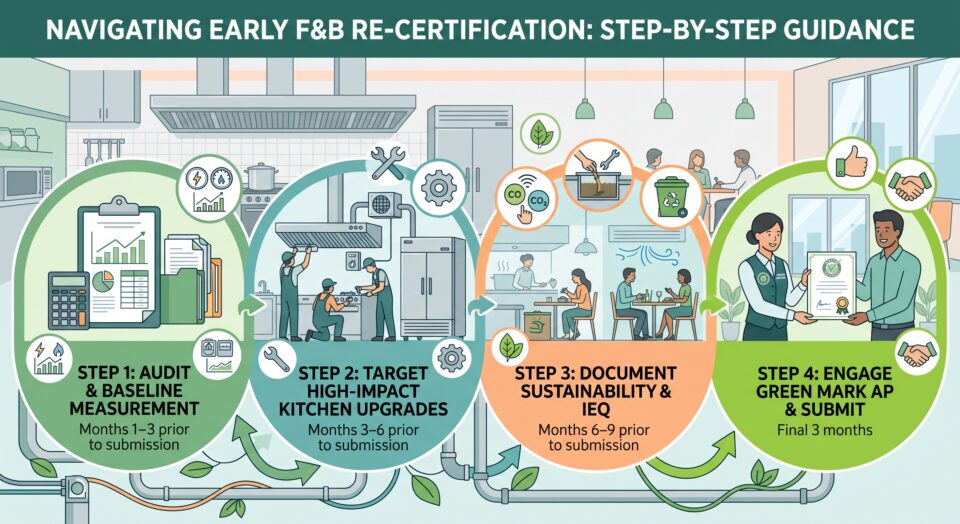
Step-by-Step Guidance: Navigating the Re-Certification Process

Months 1–3 prior to submission.

1. Audit & Baseline Measurement:

Gather 12 to 24 months of utility data, sub-metering logs, and maintenance records. Calculate your current Energy Use Intensity (EUI in kWh/m²/year) to identify baseline efficiency shifts since your previous assessment.

Months 3–6 prior to submission

2. Target High-Impact Kitchen Upgrades

Implement low-friction, high-yield interventions:

  • Demand Control Ventilation (DCV): Retrofit kitchen exhaust hoods with variable speed drives (VSDs) and sensors that dynamically scale fan speed based on cooking activity.

  • Refrigeration & Heat Recovery: Recover waste heat from commercial chillers/coolers to pre-heat water for dishwashing.

  • Sub-Metering Integrity: Ensure M&E sub-meters for high-load equipment (cooking line, cold rooms, lighting) are functional and logging continuous operational data.


Months 6–9 prior to submission
3. Document Sustainability & Indoor Environment Quality (IEQ)

3.Document Sustainability & Indoor Environment Quality (IEQ):Months 6–9 prior to submission.

F&B operations heavily impact indoor air quality and waste streams. Compile evidence across key non-energy parameters:

  • Indoor Air Quality: Verification of carbon monoxide (CO) and carbon dioxide (CO₂) monitoring in cooking and dining spaces.

  • Water & Waste Management: Metering for dishwashers, low-flow water fittings, grease trap maintenance logs, and food waste digester/composting reports.

Final 3 months

4.Engage a Green Mark Accredited Professional (GMAP) & Submit:

Work with a GMAP to perform a pre-audit gap analysis, consolidate documentation, and submit the re-certification application via the BCA Green Mark portal. Coordinate the mandatory site verification audit with BCA assessors.


Strategic Advice: Re-Certification Pitfalls to Avoid

Common Re-Certification Trap Operational Impact Prevention Strategy
Gaps in Continuous Sub-metering Unmonitored utility bills lead to audit disqualification. Install automated cloud-logging sub-meters on high-draw kitchen circuits rather than relying on manual readouts.
Uncalibrated Kitchen Hood VSDs Exhaust running at 100% capacity constantly, spiking EUI. Schedule bi-annual sensor calibration and airflow balancing prior to audit cycles.
Siloed Maintenance Logs Missing service records for refrigeration and grease traps during site visits. Centralize all preventive maintenance digital receipts into a single compliance drive for audit inspection.

Annual Preventive Maintenance & Calibration Schedule

Frequency System / Equipment Maintenance & Calibration Tasks Target Criteria / Audit Proof
Bi-Weekly Electrostatic Precipitators (ESP) Remove ionizing and collector cells. Soak in degreasing solution, pressure wash, and dry thoroughly. Inspect ionizer wires for breakage or bending. Clean collector plates; zero arc/sparking faults logged.
Monthly Demand Control Ventilation (DCV) Clean optics on infrared/optical sensors in hood canopy. Wipe down temperature sensors to remove grease/soot build-up. Sensor lenses clear; correct baseline temperature readings.
Quarterly IAQ Monitors (CO / CO₂ / TVOC) Perform zero-point check and span calibration using reference gases for kitchen CO and dining area CO₂ sensors. Clean air intake grilles on monitors. Sensor readings within $\pm 5\%$ accuracy against reference gas standard.
Quarterly ESP Electrical & UV-C Lamps Check high-voltage power packs, door interlocks, and insulator bushings. Clean UV-C lamps (if equipped) to maintain ozone/breakdown efficiency. Stable operating voltage; high-voltage indicator status normal.
Semi-Annually DCV System Calibration Calibrate temperature and optical sensor response thresholds. Verify VSD fan speed modulation (e.g., $30\%$ idle speed ramping up to $100\%$ upon cooking thermal load). VSD signal matches hood load; energy reduction verified during idle periods.
Semi-Annually Exhaust Ducting & Hoods Professional degreasing of primary kitchen hood interior, grease gutters, and vertical duct riser access panels. Certified cleaning report from NEA/SCDF-approved specialist vendor.
Annually Full System Air Balancing & IAQ Audit Conduct complete airflow balancing test for exhaust vs. makeup air. Recalibrate third-party IAQ transmitters with factory reference or certified replacement heads. Air balancing report confirming negative kitchen pressure; 3rd-party calibration certificates.

Key Compliance Documentation for Re-Certification

  • Calibration Certificates: Retain all vendor-issued calibration certificates for CO, $\text{CO}_2$, and temperature sensors (must show date and standard gas batch numbers).

  • Vendor Service Reports: Maintain a digital log of all quarterly ESP degreasing and duct cleaning service sheets.

  • Trend Logs: Keep 12 months of exported continuous data showing DCV fan speed modulation alongside IAQ sensor readings.


Engaging an ES Management (ES.SG) consultancy is crucial for navigating the shift toward operational, data-led compliance under the BCA Green Mark 2021 (GM:2021) framework. Because certifications carry a strict three-year validity period, engaging specialized ES partners ensures buildings transition smoothly from initial award standards to continuous in-operation benchmarks.

Core Value Deliverables of ES Management in Re-Certification

  • Independent Performance Auditing: ES Management teams execute essential gap analyses to identify performance drift across central chiller plants, lighting power density, and indoor air quality (IAQ) loops.

  • Measurement & Verification (M&V) Optimization: Specialists ensure that sub-meters, flow sensors, and Building Management Systems (BMS) accurately capture continuous operational data and Energy Use Intensity (EUI) metrics required for site audits.

  • Grant & Incentive Navigation: Consultants align necessary retro-commissioning or equipment upgrades with government co-funding schemes and green financing frameworks.

  • Documentation & Submission Management: ES assessors oversee the end-to-end portal submission, coordinating pre-audits and site verification visits with appointed BCA assessors to ensure seamless re-certification.

Related posts