
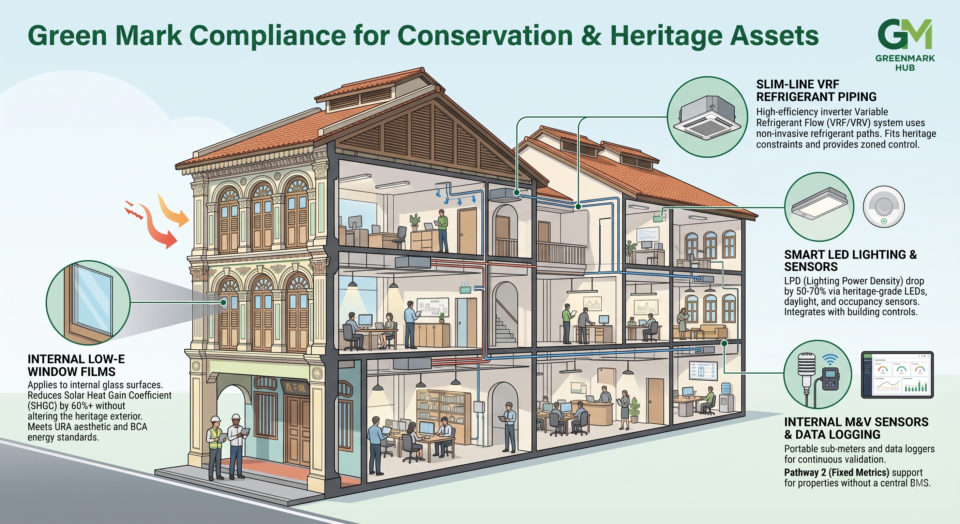
Managing gazetted conservation shophouses, heritage commercial assets, or older low-rise commercial properties in historic precincts (like Chinatown, Tanjong Pagar, and Civic District) presents a formidable structural puzzle.
Unlike modern Grade-A office towers engineered for high-efficiency MEP (Mechanical, Electrical, and Plumbing) integration, heritage buildings operate under severe physical constraints:
-
No Facade or Structural Alterations: Strict Urban Redevelopment Authority (URA) conservation guidelines forbid mounting external equipment, window film tinting that alters facade aesthetics, or visible ductwork.
-
Zero Rooftop Solar Capacity: Timber-truss or tile roofs cannot support the structural dead-load of rooftop solar PV arrays, eliminating the easiest renewable energy offset pathway.
-
Cramped Mechanical Spaces: Lacking central plant rooms or dedicated riser shafts, these buildings rely on scattered, aging air-cooled split-units or small VRF systems.
When owners of heritage commercial assets receive an MEI notice or Green Mark re-certification requirement, they often feel trapped—assuming compliance is physically impossible without violating conservation laws.
The Core Challenge: The Structural Constraint Trap
Traditional Green Mark compliance strategies rely heavily on big-ticket hardware overhauls: installing massive water-cooled chillers, erecting rooftop solar arrays, or re-insulating building envelopes.
For a conservation building, none of these options are legally or structurally viable.
The Heritage Compliance Playbook (GM:2021 Pathway 2)
BCA’s GM:2021 framework provides flexible alternative pathways specifically designed to keep heritage and constrained assets fully compliant:
-
Leveraging GM:2021 Pathway 2 (Fixed Metrics): Instead of relying on whole-building energy modeling or solar offsets, heritage assets can achieve compliance by satisfying targeted, high-performance prescriptive criteria across controllable sub-systems.
-
High-Efficiency Inverter VRF Retrofits: Replacing outdated split-units with ultra-high-efficiency Variable Refrigerant Flow (VRF/VRV) systems with heat recovery delivers up to 40% energy reduction using existing slim refrigerant piping paths—requiring zero structural modification.
-
Internal Thermal Envelope Upgrades: Applying clear, non-reflective low-E window films to internal glass surfaces reduces solar heat gain coefficient (SHGC) without changing the historical exterior facade appearance.
-
Smart Lighting Power Density (LPD) Drops: Dropping internal lighting energy by 60% through architectural heritage-grade LED retrofits and occupancy sensors provides a massive low-CapEx EUI reduction that compensates for envelope limitations.
The Bottom Line
Preserving historic architecture and achieving modern BCA Green Mark compliance are not mutually exclusive. By utilizing flexible GM:2021 pathways, internal envelope retrofits, and high-efficiency VRF systems, heritage property owners secure full regulatory compliance without altering a single historic brick.