The AGM Predicament: How MCSTs Avoid Sinking Fund Depletion from Post-Audit Energy Penalties
For any Management Corporation Strata Title (MCST) Council or Managing Agent (MA) in Singapore, few scenarios trigger as much dread as an unexpected line item on the annual statement. When an Energy Efficiency Improvement Plan (EEIP) notice or post-audit compliance mandate arrives under Singapore’s regulatory framework, Council members face a room of subsidiary proprietors demanding to know why their Sinking Fund is being drained—or worse, why maintenance fees need to be raised.
With the Building and Construction Authority (BCA) enforcing stricter operational standards under GM:2021 (Green Mark 2021) and mandatory Mandatory Energy Improvement (MEI) regimes, condo MCSTs can no longer treat common area performance as a set-and-forget line item. Passing re-certification without triggering a budget crisis requires moving from reactive panic to strategic preparation.
Why MCSTs Get Caught Off Guard on Audit Day
Most residential and commercial strata developments don’t fail energy audits because of catastrophic equipment collapses. They fail because of operational drift that pushes their Energy Use Intensity (EUI) (kWh/m2/yr) past allowable baseline limits.
-
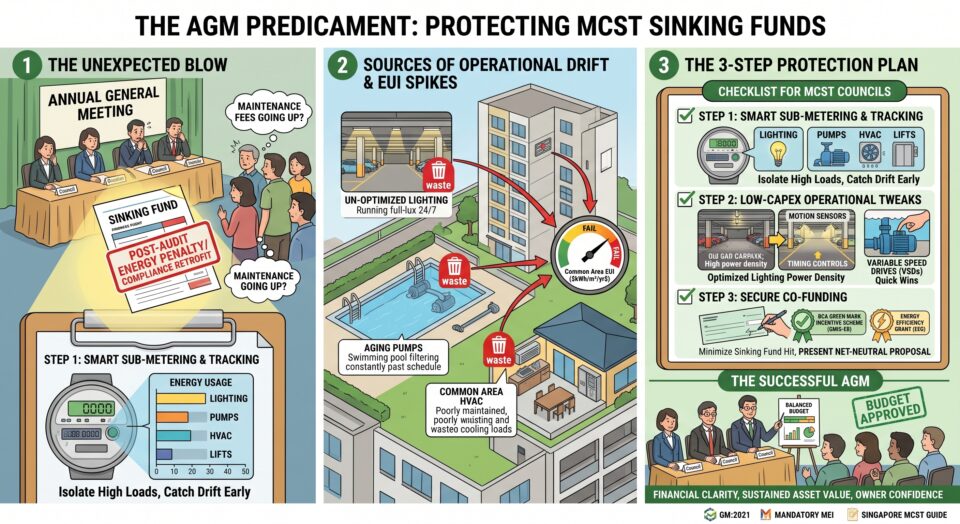
Common Area EUI Spikes: Multi-storey carparks running full-lux lighting 24/7, aging water feature pumps operating past schedule, and un-optimized clubhouse HVAC systems silently inflate operational carbon and energy consumption.
-
The “As-Built” Baseline Illusion: Relying on historic Fixed Metrics or design-stage Energy Modelling numbers while real-world equipment performance has degraded over the 3-year audit cycle.
-
The Panic-Retrofit Premium: Waiting until a formal audit notice leaves the Council with weeks to fix deficiencies. Emergency equipment replacement costs 2–3x more than scheduled retrofits, forcing an immediate draft on the Sinking Fund.
The Financial Fallout: Management Fund vs. Sinking Fund
When non-compliance forces emergency mechanical retrofits to meet minimum energy performance thresholds, the Management Fund rarely has the buffer to absorb the hit. Councils are forced to tap into the Sinking Fund—which is explicitly earmarked for long-term capital replacement like repainting, lift overhauls, and waterproofing.
Furthermore, failing to maintain continuous operational efficiency risks losing targeted GM:2021 Sustainability Badges—specifically Maintainability (Mt) and Intelligence (In)—which safeguard long-term asset value. Depleting Sinking Funds for avoidable emergency fixes leads to rejected AGM budgets and severe pushback on Council re-elections.
The 3-Step MCST Action Plan to Protect Your Funds
1. Track Energy Pathways with Targeted Sub-Metering
You cannot manage what you do not measure. Installing smart sub-meters aligned with GM:2021 Pathway 1 (EUI Tracking) on major common area loads—carpark ventilation, pool filtration, corridor lighting, and lifts—allows the MA to catch energy drift months before an auditor steps on site.
2. Execute Low-CAPEX Operational Tweaks
Passing re-certification doesn’t always require replacing major chillers. High-impact, low-cost fixes target quick Maintainability wins:
-
Retrofitting motion sensors and timing controls in carparks and fire stairwells to optimize lighting power density.
-
Installing variable speed drives (VSDs) on existing pump systems.
-
Re-balancing air distribution in shared indoor facilities to eliminate unnecessary cooling loads.
3. Leverage Co-Funding Before AGM Budgeting
Before presenting any capital outlay to homeowners, explore available funding schemes like the Energy Efficiency Grant (EEG) or BCA’s Green Mark Incentive Scheme for Existing Buildings (GMIS-EB). Structuring retrofits around co-funding allows the Council to present a net-neutral proposal at the AGM, protecting the Sinking Fund while positioning the property toward Super Low Energy (SLE) standards.
By addressing common area EUI drift early, MCST Councils can walk into their next AGM with total financial clarity—defending both their building’s asset value and their owners’ wallets.
Let ES Management handle the hassle. We offer a completely fuss-free Green Mark Re-Certification Consultant service, ensuring you meet BCA’s standards without the headache.
Visit ES.SG/ +65 9107 0587/ eddie@es-mgt.com
Focus on your business while we manage the compliance. Get started today for just S$6990*.
*Terms and conditions apply.