
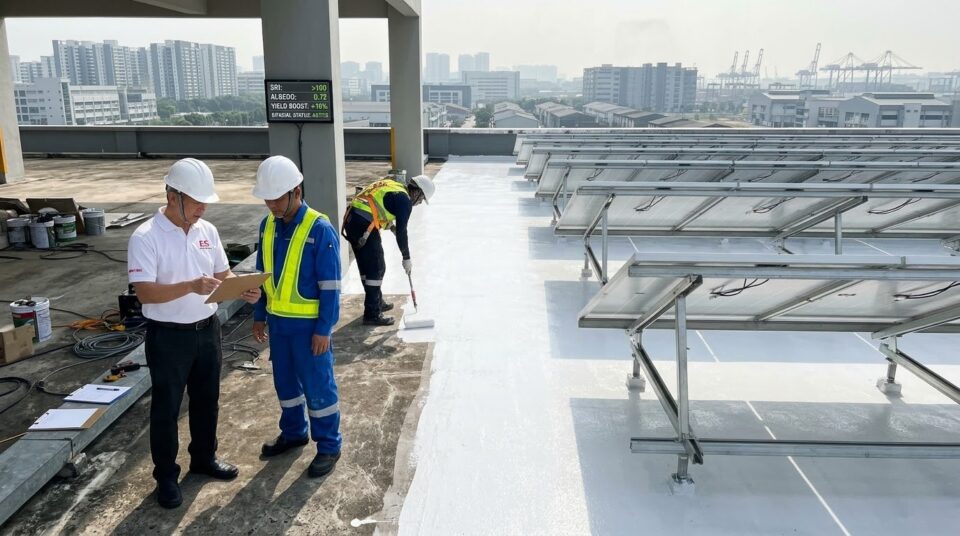
When building owners and MCST councils attempt to elevate an aging commercial or B1 industrial asset to BCA Green Mark Platinum or Super Low Energy (SLE) status, the central barrier is almost always the chiller plant. Replacing a 15-year-old centrifugal cooling system to meet current efficiency benchmarks can trigger immense capital expenditure (CAPEX), bypass warranty boundaries, and risk critical operational downtime.
However, under the updated Green Mark 2.0 (GM:2021) framework, smart assets are bypassing this overhaul entirely—on paper—by leveraging a high-yield combination on their rooftops: Bifacial Photovoltaic (PV) arrays paired with high-reflectivity (albedo) cool roof coatings.
By utilizing onsite renewable energy as a mathematical offset, FMs can neutralize efficiency deficits in aging mechanical systems without touching a single chiller or production power meter.
[ THE "ON-PAPER" CHILLER OFFSET ]

   Aging Central Chiller Plant                      Rooftop Offset System
  ─────────────────────────────                 ───────────────────────────────
   Inadequate Efficiency                         Bifacial Solar (Double-Sided)
   (e.g., > 0.85 kW/RT)                          + High-Albedo White Cool Roof
         │                                                     │
         ▼                                                     ▼
   EUI Deficit                                   Direct Energy Contribution
   (kWh/m²/yr penalty)                           (1,150 to 1,250 kWh/kWp/yr)
         │                                                     │
         └─────────────────────────┬───────────────────────────┘
                                   │
                                   ▼
                [ Mathematically Meets SLE/Platinum ]
                   (Without replacing the chiller)
The Mathematical Lever: The EUI Offset
To meet Singapore’s stringent Energy Efficiency (EE) prerequisites, a building must verify a target Energy Use Intensity (\text{kWh/m}^2/\text{yr}). If your older chiller plant is running sub-optimally at > 0.85kW/RT, your resulting EUI will inevitably fail to meet the baseline needed for top-tier certification.
BCA’s Green Mark 2.0 allows you to deduct 100% of your generated onsite solar energy directly from your building’s gross consumption before calculating the final EUI. This creates an onsite offset: every kilowatt-hour generated on your roof directly cancels out the efficiency shortfalls of your mechanical systems downstairs.
Understanding the Upgrade
                       Sunlight
                          │
                ┌─────────▼─────────┐
                │   Bifacial Solar  │ ──(Top-side: Direct generation)
                │    Panel Array    │
                └─────────▲─────────┘
                          │ (Albedo reflection)
     High-Albedo          │
     White Coating ───────┴── Roof Surface
1. Why Bifacial Panels?
Conventional (monofacial) solar panels only generate power from their top-facing side. Bifacial panels feature dual-sided active PV cells, allowing them to capture direct sunlight on the top and reflected ambient light (albedo) on the underside. In Singapore’s high-cloud-cover, high-diffuse-irradiation tropical environment, this underside generation adds 0.10–0.20 additional power yield compared to traditional panels.
2. The Multiplier: High-Albedo “Cool Roof” Enhancement
The albedo of a standard dark concrete or weathered asphalt roof is extremely low (0.10–0.15), meaning it absorbs heat and reflects almost no light.
By applying a high-reflectivity, high-albedo white elastomeric coating (with a Solar Reflectance Index, SRI > 100) to the roof substrate, you elevate the surface albedo to over 0.70. This turns the entire roof into a massive mirror:
The Generation Boost: Underside reflective yield on the bifacial panels spikes, pushing the total specific yield to 1150\text{--}1250\text{ kWh/kWp/yr}
.The Passive Thermal Benefit: The high-reflectivity coating prevents the roof from absorbing solar radiation. This reduces the heat transfer into the building’s top-floor spaces, dropping local air conditioning loads and further lowering your gross EUI.
Key Financial & Technical Metrics
To ensure an upgrade of this scale delivers on paper and on the balance sheet, the following parameters should be verified during pre-assessment:
- Differential Pressure (Indoor): Maintaining sensor-driven
\Delta P < 120\text{ Pa}on mechanical ventilation ensures optimized base energy demands before applying solar generation offsets.
- Central Plant Target: For assets aiming for SLE or Platinum, offsetting aging chiller performance (
0.85\text{ kW/RT}) via PV reduces the need for immediate chiller replacements.
- Albedo (SRI): Roof coatings must maintain SRI > 100 and be periodically washed to prevent dust degradation from lowering back-side yield.