
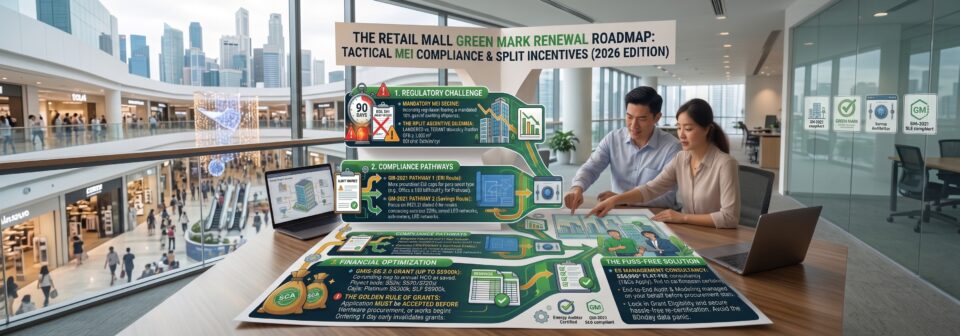
When the Building and Construction Authority (BCA) issues a Mandatory Energy Improvement (MEI) audit notice to a retail mall, asset directors and facility managers face a unique operational dilemma. Operating on continuous 14-to-16-hour daily cooling cycles with intensive weekend peak loads, shopping centers are among the heaviest energy consumers per square meter in Singapore’s commercial built environment.
Under the MEI regime, existing buildings with a Gross Floor Area (\text{GFA} \ge 5,000\text{ m}^2) flagged in the bottom 25th percentile of energy performance must achieve a mandatory 10% reduction in Energy Use Intensity (EUI) within three years.
For retail properties, hitting this target is rarely just a mechanical engineering challenge—it is an administrative and legal puzzle known as the split-incentive problem. Below is the tactical roadmap for retail asset managers to navigate tenant energy boundaries, optimize central cooling plants, and capture up to S$900,000 in government grant co-funding before procurement begins.
1. The Retail EUI Challenge: Common Area vs. Tenant Footprints
Calculating an accurate baseline EUI ($\text{kWh/m}^2/\text{yr}$) for a retail asset requires separating landlord-controlled energy from tenant-consumed power:
\text{EUI} = \frac{\text{Total Annual Building Electricity Consumption (kWh)}}{\text{Gross Floor Area (GFA in m}^2)}
The Split-Incentive Dilemma
In a typical retail lease structure, the landlord pays for capital upgrades to the central chiller plant and common area services (escalators, atrium lighting, mechanical ventilation), while retail tenants pay for their own direct utility draw based on sub-metering or fixed service charges.
This creates a friction point during an MEI audit:
-
Landlord CAPEX vs. Tenant Benefit: Upgrading central cooling infrastructure requires significant landlord capital, but a primary beneficiary of improved air-handling efficiency is the tenant’s thermal environment.
-
Tenant Fit-Out Loads: High-density food & beverage (F&B) tenants, commercial kitchens, and specialty anchor stores generate massive heat gains and exhaust loads that force the central plant to work harder, directly inflating the building’s overall EUI.
Resolving the Interface via GM:2021
Under Green Mark 2.0 (GM:2021), landlords can resolve this boundary issue through strategic sub-metering and smart lease structuring:
-
Digital Sub-Metering Networks: Installing certified digital sub-meters at key tenant distribution boards separates tenant plug loads from the building’s base-building operational EUI.
-
Green Lease Schedules: Introducing energy performance clauses during lease renewals obligates tenants to maintain minimum efficiency thresholds for lighting densities and fit-out Fan Coil Units (FCUs).
2. Compliance Pathways: Tackling F&B Exhaust and Thermal Loads
To achieve the mandatory 10% EUI reduction, retail asset managers must select the right compliance pathway under GM:2021:
Pathway 1: Prescriptive Hardware Upgrades
Pathway 1 focuses on strict hardware efficiency caps across all base-building equipment. For retail assets, key requirements include:
-
Central Chiller Plant Efficiency: Must achieve $\le 0.68\text{ kW/RT}$ for Platinum or Super Low Energy (SLE) performance.
-
Variable Speed Drives (VSDs): Mandatory installation on chilled water pumps and Air Handling Units (AHUs). Under the VSD Affinity Law (P \propto N^3), modulating AHU fan speeds to match variable weekday vs. weekend footfall reduces motor power consumption quadratically.
-
Smart LED Networks: Complete transition of atrium, basement car park, and common corridor lighting to high-efficacy LED fittings with occupancy sensors.
Pathway 2: Outcome-Based Savings (The F&B Solution)
For suburban malls or dining hubs with heavy F&B footprints, rigid hardware caps under Pathway 1 can be difficult to enforce across diverse tenant spaces. Pathway 2 (Outcome-Based) measures total operational carbon avoided ((tCO_{2}e)) over 12 months post-retrofit.
This pathway allows landlords to implement holistic thermal recovery measures, such as:
-
Variable-flow kitchen exhaust hoods that ramp down extraction during off-peak dining hours.
-
Heat recovery exchangers that capture condenser waste heat to pre-heat domestic hot water for restaurant tenants.
3. Financial Optimization: Capturing GMIS-EB 2.0 Grants
Because retail malls operate continuously and consume high volumes of baseline energy, their total carbon reduction potential ((tCO_{2}e)) is substantial. This makes retail assets prime candidates for maximum co-funding under the Green Mark Incentive Scheme for Existing Buildings (GMIS-EB 2.0).
Grant Quantum Breakdown
GMIS-EB 2.0 provides outcome-based cash payouts based on annual metric tons of carbon dioxide equivalent ((tCO_{2}e)) saved:
-
Platinum Target: Funded at $S\$25/(tCO_{2}e), capped at S$600,000.
-
Super Low Energy (SLE) Target: Funded at $S\$35/(tCO_{2}e), capped at S$900,000.
-
Zero Energy (ZE) Target: Funded at $S\$45/(tCO_{2}e), capped at S$1,200,000.
The Non-Negotiable “Golden Rule” of Grants
Across all Singapore building grant frameworks (including GMIS-EB 2.0 and the Enterprise SG Energy Efficiency Grant), grant applications must be formally submitted and accepted by BCA BEFORE any equipment procurement, vendor contracts, or retrofit works commence.
Executing a purchase order for a new chiller or signing an ESCO contract just one day prior to official grant approval results in complete forfeiture of grant eligibility.
Protect Your Mall’s NOI with ES Management
Navigating the MEI 90-day audit window while balancing tenant lease dynamics does not have to threaten your property’s Net Operating Income (NOI).
At ES Management, we provide complete administrative and technical certainty for retail asset managers:
-
Flat-Fee Consultancy: End-to-end Green Mark Re-Certification and MEI audit management starting at a fixed S$6,990* (T&Cs apply).
-
Grant Securing: We handle all baseline EUI modeling, sub-metering gap analysis, and BCA grant submissions before any procurement commitments are made.
-
Zero Upfront CAPEX Options: We structure Energy Performance Contracts (EPC) where equipment retrofits are fully funded out of verifiable monthly electricity bill savings.
Lock in your grant eligibility and eliminate compliance panic. Contact ES Management today for a hassle-free retail audit assessment.